
Common Beginner Knitting Mistakes and How to Fix Them
May contain affiliate links (what's this?)
You’ve decided to take up knitting. Good for you! You’ve mastered how to knit and you’re chugging along, happily knitting a little garter stitch scarf or cowl.
Everything’s copacetic until you realise that you’ve dropped a stitch – ack! – or you’ve added extra stitches – where did those come from? – or maybe your knitting’s awesome except that it’s so tight you practically sprain a muscle trying to get your needle into the stitches.
As frightening as these scenarios sound, you are not alone!
Past and future knitters have and will be making these same mistakes. So, when you encounter them, don’t freak out.
Knitting mistakes are part of the natural course of things. So, let’s take a closer look at these common beginner bugaboos and the best ways to fix them.
Knitting Mistake 1: Dropped Stitches
At some point you will drop a stitch. It’s an unfortunate fact of life as certain as death and taxes.
You’ll recognise a dropped stitch by a long tear in your fabric and a wayward stitch at the bottom. When this happens, don’t panic!
As frightening as it looks – so sad and helpless, like a child fallen into a well – it’s nothing to fret about.
On stockinette and garter stitch it takes less than a minute to fix, and when you’re done no one will be any the wiser!
Panic Level: LOW
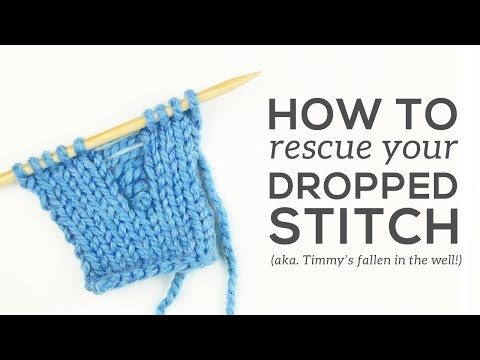
Click This: For a more detailed guide on how to fix a dropped stitch, check out this post I put together with a photo guide.
Knitting Mistake 2: Adding Stitches
At some point, you might look down at your knitting and think,“Whoa! Why do I have so many stitches on my needle?”
You’ve got more stitches than you cast on! You, my friend, have accidentally added extra stitches to your knitting.
This knitting mistake happens to most beginner knitters, so don’t beat yourself up about it.
There’s one way to fix an added stitch, but it requires that you keep your eyes peeled so that you catch the little sneak before it gets embedded into your knitting.
Panic Level: MODERATE

Click This: For a more detailed guide on how to fix extra stitches, check out this post I wrote with a photo guide.
Knitting Mistake 3: Tight Knitting
When you’re first starting out as a knitter, you’re excited and nervous.
But sometimes the nerves take over and you start gripping the needles and pulling the yarn. You’re scared your stitches will fall off.
But the problem is that your knitting is so tight you can barely get your needles into the stitches. You’re going to pull a muscle if you don’t take it easy!
Below, three ways to loosen up tight knitting.
Panic Level: DON’T PANIC

Click This: For a more detailed guide, check out this post that I put together on tight knitting.
Knitting Mistake 4: Knitting into the Wrong Loop
As a beginner it can be hard to differentiate a stitch versus a random loop.
This mistake happens when, instead of knitting into a stitch on your needle, you knit into the loop around the stitch.
If you knit into the loop around the stitch and then knit into the actual stitch, this adds an extra stitch to the knitting.
If you’ve only done this once or twice, you can reduce the overall number of stitches by knitting two stitches together.
But if you’ve got LOTS of these extra stitches, it’s worthwhile to unravel the knitting and re-knit.
The best way to prevent this mistake is to be observant.
Ensure you’re knitting into the stitch on the needle and not into the loop around the stitch.
Panic Level: Moderate

How to Prevent Knitting Mistakes?
The best way to prevent these three common knitting mistakes is to frequently admire your work.
It’s not narcissistic. It’s just good knitting sense!
If something looks funky, stop and investigate.
Did you accidentally do a yarn over?
Are you knitting on the tips of your needles?
Like weird skin rashes, ignoring knitting problems rarely makes it go away. So, be vigilant!
And when you need to rip back your work, take a deep breath and rip, rip, rip.
Lastly, don’t even think about getting upset when you make a mistake.
The person who never made a mistake never made anything. So make mistakes!
Mistakes mean you’re creating, and that’s a heckuva lot better than doing nothing.
If you’re a new knitter, I hope you’re getting the hang of knitting! Let me know if you encounter any of these knitting mistakes.
If there are others that I haven’t covered, leave them in the comments!


Hi Davina,
I just ripped my work to zero because I couldn’t figure out where I added an extra stitch!!! It’s not that I didn’t look. But I couldn’t see it. And it wasn’t a yarn over :'[ So back to cast on.
This is sooooo helpful. Now I know how to spot them and correct them … My books were not as clear as your videos. Thank you soooo much
Hey Virginia! Glad I can help!
The thing with mistakes is that if you make them enough, you’ll eventually be able to spot them a mile away – and fix them really easily!
I have realized, that at times (especially if I knit too tightly) I have actually created a stitch but cutting right into the yarn. Essentially turning previously one stitch into two. We learn from our mistakes! 🙂
Hi! Thanks a lot for this. I am a total beginner, and have started working on a muffler for my first project. Unfortunately, I have missed a stitch and don’t know where or how to locate it. The video you’ve posted here is not viewable to me as video content is blocked at my university. Please help if you can.
Hi April, Yikes! It’ll be hard to illustrate how to pick up a missed stitch without being able to view the video! Is YouTube completely blocked at your university?
Hello – I am making a slouchy hat and when I was doing the increase round I counted two extra stitches. I should only have 60 stitches. The two extra are at the beginning of what will be knit rounds. Should I knit these two together or take them off ? Thanks for your help.
If you’re not to far into your knitting, I would just rip out the stitches and try the increase round again. Once you increase to 60 sts, stop increasing. Don’t add in any more stitches since 60 is exactly what you need. Hope that helps!
I’m making a slouchy hat with a 16 row lace pattern within it, so there’s lotsa holes and yarnovers and s2kp. This last round I was one stitch short. I must have dropped a stitch, but I can’t find it.
Help!
Thank you!
Hey Fancy, Holes, yarnovers and S2KPs, oh my! You’re in Lace Country! To be honest, I’m not sure how to help you find your dropped stitch since I can’t see your knitting or your pattern. The good news is that since you’re knitting lace, it’s unlikely anyone will notice that a stitch was dropped. I’m wary of telling you to add in an extra stitch by doing an MI because it may throw off your lace pattern entirely. Lace is tricky!
That’s why many lace knitters will incorporate what are called “lifelines” every few repeats. This involves using a scrap piece of yarn (or sometimes dental floss for its smoothness) and weaving it into a row of your stitches. These basically “hold” the stitches so that if you make a mistake later on, you can rip back your work to your lifeline and pick up those stitches rather than ripping back all the way to the beginning (horror!). Just remember to mark down the row where you placed your most recent lifeline so you know where to start your knitting should you need to rip back to that lifeline.
So, going forward, I would suggest using lifelines in your lace knitting until you feel super comfortable with the lace pattern. Hope this helps! And best of luck navigating Lace Country!
Knitting a dishcloth “Truly Tectured” and all pulls were on the right side. Now I come back to it and the purls are on the wrong side. Can’t figure out what I am doing wrong.
Hey Suzanne, maybe you purled on the on the wrong row? That’s my best guess! You might want to rip back to the place where the knitting looks OK and then take it from there, provided that you can find your place in the pattern again!
Hello, Davina. As a complete beginner, the clear demonstrations in your videos helped me fix a little mistake in my first project while panicking and helped me loosen up my knitting.
I cannot thank you enough, honestly!
That’s awesome! Glad I could help you out of your knitting snafu. I totally relate to the panic!
Hi Davina, how are you.
Your videos have been great
I am a beginner and I’m stuck
I have been adding stitches and yes I have seen that video and went back to fix my work but I have been picking up stitches when I go from knit to a stocking stitch. So I knit 3 stitches then I go to do a stocking stich and I end up with 5 not four. Please help
Thanks Vanessa
Hey Vanessa! My advice would be to be really careful about each stitch you knit! Before you start a new row, make sure you’re starting with the right number of stitches. Then, make sure that the stitches that you knit are actually stitches and not an area *between* your stitches. Hope that helps!
Thanks so much for the tip about tight knitting! I am a beginner knitter and I’m using 5mm steel needles with super tight stitches. So I really appreciate the advice that I should try out some bamboo needles and thicker yarn. I’m excited to test that out and see if it helps. Thanks!
Thanks Jheri! Glad I can help. As your hands get used to knitting and learn the “language” of knitting, they will naturally relax and grip the needles less tightly, resulting in less tight stitches. Good luck!
Hi Davina!
Thank you so much for posting these videos of what can, what might and what WILL happen.
I am experiencing all the above (lol). I spend more time ripping apart my work than actually knitting something! What I will ask is for a beginner, who has never ever knitted a day in her life, what type of knitting needles should someone like me start off with? I have a 14 inch size 15 needles…… we’re not getting along 🙁 In addition, I’m having problems trying to hold these needles. Please make a video on several ways to hold knitting needles.
Thanks!
Hey Jonaye,
Maybe the US 15 needles are a bit too bulky for you. You can try a 5mm or 6mm. They’re not so small that you have to grip them hard and not so big that you feel clumsy holding them. I recommend starting with bamboo needles because they are less slippery than steel needles. They have more surface drag, so the stitches are less likely to fall off.
Ways to hold knitting needles! That’s a thought! I’ll throw that on my list of tutorial ideas. Thanks!
Hi there. Thanks so much for the videos. I’m having another problem. I am knitting a cowl on a round. I N10 and P10 and I’m noticing that the junction between that knit stitch and purl is getting loser and loser. I have increased the tension but it doesn’t seem to be helping. I’ve also started doing a reverse purl stitch as that makes the stitches tighter. But all in all the problem is continuing. Any suggestions?
Thanks so much.
Hey Pamela, is the gap occurring at the cast on edge only? If so, you can easily close up that gap by weaving in the tail end of your yarn from the longtail cast on and closing up the gap that way. If the gap is travelling up your knitting at the join, then the problem could be your stitch marker. Is it quite wide? I find that a big stitch marker can unintentionally widen that gap. You can try to use just a piece of string tied in a loop as a stitch marker and see if that doesn’t help. The other option is to upload a photo of your work so that I can see exactly what’s going on!
HELP! I am knitting a scarf, alternately lacy for 10 rows, then garter stitch for 10 rows, starred with 5 rows of garter stitch and the sides are developing a slant. What causes this and how can I correct it other than blocking when I am finished. Thank you for your help.
Hey LaNell! It really depends on your pattern! Some lace patterns have a bias, meaning that they will slant to the left or right if the decreases aren’t evened out. For instance, if the pattern only has right-leaning decreases, guess which side the lace will lean towards? Sometimes this is the design of the pattern and sometimes it’s a matter of adding in a right or left-leaning decrease so that you have an even number of both right and left decrease. I would try to contact the pattern writer first as she or he can probably give you the best insight!
So I have increased (accidentally) by 8 stitches can I just do a decrease to get the extra ones off? I have knitted 5 rows of 77 stitches and I am NOT starting over. I don’t see any holes but I think my thread split so it looked like I had dropped a stitch (it was hanging on by a thread of the yarn) so I grabbed it up and knitted that sucker. I am thinking decrease two on each end. I’m doing my first hat!
Hey Maria, First hat! Good job! As for your increased stitches… to be honest, I would personally just rip out the work and redo it since you’re only 5 rows in. I know it feels like a lot since you’ve got 77 stitches, but to increase by 8 stitches means that you’ve increased over 10% of your total number of cast on stitches!
If you really don’t want to redo, you can decrease those extra stitches away so that you’re back to 77 stitches. For instance, you can do 8 k2togs evenly across a row. Just beware that doing this may cause some puckering.
Hope this helps, and good luck with your hat!
So I’m knitting my second project, a simple scarf… And I started with 22 stitches, I’m up to 29! Lol it’s not completely obvious (to me at least) and have no clue where they came from! Do you count your stitches every row?
Hey Rach! If you find that mysterious stitches are appearing in your work, it’s likely that you’re accidentally adding them! I have a video on why this happens and what to do about them: https://youtu.be/1oP6EyCT93g
As for whether I count my stitches every row, I don’t do that unless there’s an increase row or a decrease row in my pattern at which point the pattern will tell you the new number of stitches you should have.
I’d suggest that you keep an eye on your rows as you knit them to make sure you’re not accidentally slipping in a new stitch here or there. It’s a pretty common mistake for new knitters to bring their yarn up front as if to purl, and then knit into the next stitch. That accidental yarn up front ends up turning into a new stitch (and also a hole!), and that’s how new stitches end up popping up in your work.
Hope this helps!
Thank you very much for your simple videos. I’m a total beginner and found you while searching for info about picking up extra stitches. I’ve realised now that I’m actually picking up stitches when I swap between a knit row and a purl row by putting the yarn in the wrong position when I start. This gives me an extra loop to work with so I pick up a new stitch every other line (I managed an extra 4 before I realised). I’m guessing there is nothing I can do about it now that I have moved on but advice would be good.
I’m not too bothered about what I’ve done so far as I’m just practicing and not actually making anything properly yet.
Hey Liz!
It’s good that you realised where the problem starts. I’m assuming that you bring your yarn to the front of your needle as if to purl when you actually plan of knitting. When you knit into the next stitch, you create a new stitch from that strand of yarn (aka. a “yarn over”). Is that right?
This is a very common mistake for new knitters. There’s no real hack for this beyond remembering to bring your yarn to the back of your work when you start knitting.
You can always double check at the end of each row to make sure that you haven’t added new stitches. Counting is one option. You can also spread out your stitches on your needle and look for that added yarn over. It looks literally like a strand of yarn draped over the needle at an angle. It looks different from your normal stitches, which normally sit “straight” on the needle.
Beyond this, it takes a bit of old fashioned practice! I find that once your hand gets the hang of a knit stitch and a purl stitch, it will naturally bring the yarn up front for a purl and to the back for a knit. It’s muscle memory.
I hope this helps! Good luck, Liz!
Hi Davina,
I usually have the opposite problem to tight stitches. My knitting is very loose and my patterns come up much too big. If I try knitting tighter, then I have the tight stitch problem and can’t get the wool off the needle without spiking my fingers with the needle tips. I’ve been trying to knit a super chunky cardigan, but can’t go down a size as I’m already the smallest.
I’ve found the video on picking up dropped stitches very useful, I have always had to undo my work and start again.
You have saved my life! I was so close to giving up. Thank you. These videos were the most direct, simple (and adorably humerous) that I’ve found on the web. I’m decent at basic crochet and recently learned to knit via the Internet. It’s been so frustrating. Thanks so much for your help! I shall knit to see another day. ?
Aww, thanks! I’m so glad they helped you out. If there’s another knitting problem that you need help with, let me know! I’m always on the look out for good tutorial subjects!
Thank you, I was making my work so tight I could not get my needle in the next stitch you video really helped. I went out and bought bamboo needles and with your help I am doing a lot better
Hi Davina,
I love your site, it is so simple and easy to use.
I am knitting leg warmers and cast off the first one.
I forgot how many stitches I cast on.
Now I don’t know how many to do for the next one!
Please, help.
Thank You
Hey Amber, I would suggest counting up the stitches from the cast on edge. If you worked a ribbing like a 1×1 or a 2×2 ribbing, then you can count them up easily. A v-shape stitch is a knit stitch and a U-shaped stitch is purl stitch. A 1×1 ribbing means you’ll have an even number of stitches. A 2×2 ribbing means you’ll have a multiple of 4 as your cast on stitches. Does that help?
Hi Davina,
Thanks! That does help, the way that I started to count, I was off 10 stitches. It would have been too long. You are the best. I hope it doesn’t take me a year to do the second leg warmer.
Have a great week-end.
Amber
That was so much help! I started a knit with 20 stitches and when i noticed I then had 40!! stitches I had no idea what I was doing wrong. Thank you very much x
You’re very welcome! Glad it helped!
Hi Davina,
I just started knitting and I’m on my second practice swatch. After casting on and knitting my first row of stitches, I can’t help but notice that the length of yarn between my two needles slowly gets longer. This didn’t happen on my first attempt and I can’t seem to find the source of error.
Hey Sara,
I’m not sure I can picture what you mean by the length of yarn between your two needles getting longer? Do you mean that the yarn between your stitches is quite loose? Is this happening on your second row. If you used a backward loop cast on (also called the “easy cast on” in one of the How to Knit videos), then that’s pretty normal. This cast on will result in a looser first row and subsequent second row. If you continue knitting, the stitches will even themselves out. You can always upload a photo of your knitting in the comments if I’m not diagnosing this properly!