
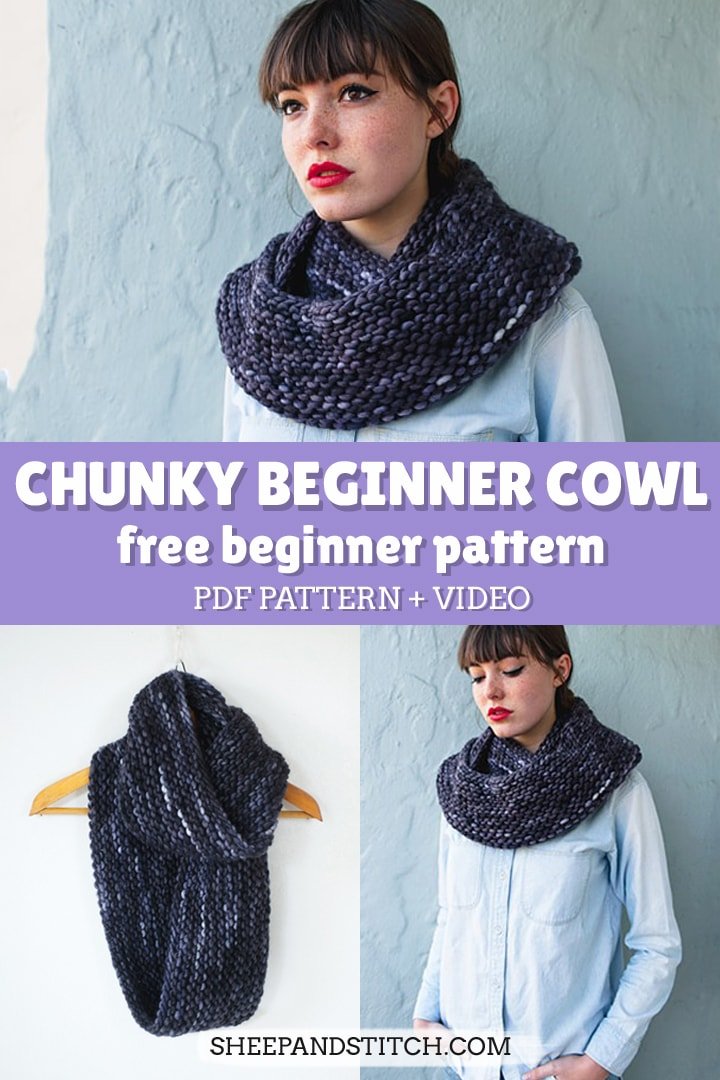
How to Knit an Infinity Scarf Beginner Pattern (Cushy Cowl)
May contain affiliate links (what's this?)An infinity scarf is a bit more challenging than a regular scarf, but not so hard as to scare off beginners.
It’s a project that introduces a few essential techniques that will move you beyond noob territory and closer to the realm of hats, socks and mittens!
Best of all, this infinity scarf is knit with super bulky yarn, which produces a thick fabric that highlights the sculptural and springy qualities of garter stitch. Super bulky yarn also knits up quick for instant gratification! Win-win!

Materials & Notes
Yarn: 2 skeins of Malabrigo Rasta Super Bulky Yarn in color Pearl Ten
Recommended Needles: 1 pair of 32″ US 17/12mm circular needle (use a needle size that gives you the gauge listed below – every knitter’s gauge is unique!)
Notions:
- large stitch markers
- retractable soft tape measure (similar)
- sharp scissors (similar)
Finished Measurements: circumference is 50” and width is 7”
Gauge: 8 sts = 4″(10cm) in garter stitch
Instructions:
Using the long-tail cast on, cast on 100 stitches and join in the round, making sure not to twist stitches.
Place a stitch marker to mark the beginning of the round.
Round 1: knit all stitches to end of round
Round 2: purl all stitches to end of round
Repeat these two rounds until piece measures 7″ or desired width.
Bind off loosely on a knit row and weave in ends.
Did You Make the Cushy Cowl? Share your project on Ravelry (aka. Facebook for knitters), add your project for the Cushy Cowl and see all the other Cushy Cowls made by knitters around the world!
You can download the pattern as a PDF file below. For best viewing, save and open the file in Adobe Reader or Preview (for Mac users). Scroll down the page to download the pattern PDF.

I have loved watching your “learn to knit” videos and I am excited to try my hand at the cushy cowl scarf. A friend of mine was a wonderful knitter and tried to teach me years ago and I did learn the stitches but never learned to make anything with them except dish cloths. I didn’t ever figure how to bind off so she always had to do it for me. I went back to crochet and haven’t tried again. While watching your videos I truly learned how to cast on, knit, purl, and cast off. I also learned how to do the long-tail cast on and now can make these beautiful cushy cowl scarves for my Christmas list next Christmas. I have 2 daughters and 3 granddaughters to make for plus a friend and her 2 daughters. I know that I can easily get 2 maybe 3 of these made per day, so I will be done with these in just a week or so. Thank you so much for a tutorial that is very easy to understand and follow. I can now say I am a beginning knitter who can make something all on her own. I’m smiling! and I know my Girls will love wearing the fruits of my labor in my new found craft. love it
Hi Lavonda! I’m delighted the How to Knit videos have helped you out! And – oh my gosh! – I’m so pleased you mastered the longtail cast on. It’s a bit finicky, right? But it’s so, so useful. Best of luck in getting 3(!) cowls done a day. I think you can do it. Invite some friends over, have some tea, knit those cowls. It’ll be a blast!
I love your tutorials! I just learned how to net and it was because of your videos. I can’t stop now!
Thank you SO much for the videos and website!
As a person that knows nothing about knitting, I’d like to ask you to create a post with tips about the materials we need to buy, such as good brands, good needles, kinds of yarn…
Thanks a lot!
I am sure I found a new hobby!
🙂
What a good idea! I’ll put that on my docket. Thanks for your suggestion, Johanna!
Hello!
I have been watching and re-watching all your videos and I am starting to get the hang of knitting! Yay.
One question: I seem to back myself into a corner with making my knit so tight that I can barely get the needles into the next knit. I can’t tell which part I am making too tight that causes this to happen?
Thanks for your help!
Hey Shy! That is awesome! I’m so glad you’re getting the hang of knitting.
As for tightness: that’s totally normal. Most beginner knitters are nervous about their stitches slipping off the needle, so they grip the needles and pull the yarn really tight when they’re making their stitches.
One solution is switching to big wooden needles. Something like a 6mm and above is a good size. The ones I use in the video are 7mm. Wooden needles are less slippery to hold, and they grip your stitches better than steel or aluminium needles. So if you can, get yourself a pair to practice with.
Another solution is to practice knitting with wool yarn. Nothing fancy, just some plain wool you can pick up at a dollar store or at Michaels, preferably heavier, like a heavy worsted or chunky weight. Wool is less slippery. It’s “grippier” for lack of a better world, so combined with a pair of wooden needles, you’ll have a great setup.
The last solution is… practice! The reason why you’re pulling your stitches so tight is because you’re nervous they’ll fall off your needle. Totally normal. However, the more you practice knitting, the less nervous you’ll become and the less tightly you’ll grip your needles. You’ll also become more confident in your hands and the way they move around your needle. As the saying goes, practice makes perfect!
Okay, this is getting to be an essay! First thing is: get a pair of wooden needles, preferably 6mm and above. Second: get some cheap, heavier-weight wool. Third: practice!
I mentioned the weight of wool. If that’s confusing, check out this post on yarn weight: https://sheepandstitch.flywheelsites.com/yarn-weight/
I hope this helps, Shy!
Thanks for the advice!! I was wondering if I was doing something wrong but it’s good to know this is usual! I will be making a shopping trip soon 😉
Great video!
If it’s a personal project for yourself and you’re using animal fiber like 100% wool, you can use a technique like spit join. Otherwise you can splice the yarn with a yarn needle if it’s not animal fiber. Both techniques literally join both yarns into one.
Just a thought.
Spit join! Yeah! You’re giving me some good ideas for future tutorial videos.
Is there a reason it seems like there is a bit of a seam even though it was knitted in the round?
Hey Nathan! Nice observation! When you knit garter stitch in the round, each new row will be higher than the one you just finished, so you’ll see a slight join where your new row meets your last row. That’s the “seam” that you’re seeing.
If you’d like no seam, you can do this:
When you begin a new purl round: Take the marker off your needle and with your yarn held in the back, slip the next stitch, purlwise, from your left needle to the right needle. Then put the marker back on your needle and purl the next round (including the stitch you slipped).
On the knit round: remove your marker and slip the first stitch from left needle to right needle, knitwise. Replace your marker and knit the round (including the stitch you slipped).
You can repeat these two rows to get a “seamless” garter stitch. What we’re doing is raising the first stitch of the last row up to the level of the new row so there’s less of a visible “seam.” The thing to remember is this: doing this moves the beginning of your round one stitch to the left, so the beginning of your round is “traveling” across your work.
This is a *slightly* advanced technique, which is why I didn’t want to introduce it to the cushy cowl since it’s a beginner project! But you’ve given me an idea to include an add-on video tutorial demonstrating this technique for those who want the extra challenge.
When you say “including the stitch you just slipped” you mean as the last stitch in the round you’ve just started, right? You slip the stitch, stitch all the other stitches in the round, and then knit or purl that slipped stitch as the 100th stitch?
Yes, that’s correct!
Hi and thank you for your videos. I have knit a bit in the past, mostly scarves, including many unfinished. Decided to start again, made a few dishcloths last week to practise something new. Then the cushy cowl. I did this slipping first stitch technique. I do still have a seam, it just travels diagonally. And my cast on/cast off/joining is a bit visible too. I will make another to practise. Maybe because I was using 10 needles with bulky instead of super bulky, the stitches are slightly looser.
I started to cast on with long-tail, but it seemed like my tail never got any shorter. I got to the 100 stitches and I had so much left I ripped it out to start over. Is there a reason this could be happening?
Hey Harrison! If everything else is working out, it might just be that you apportioned too much yarn for the longtail! It happens. The wrapping-around-the-needle way to measure is a good rule of thumb, but it’s not a sure-fire way to get an exact length. Once you get comfortable casting on with the longtail, you might develop a sixth sense for how much yarn to apportion. It’s usually a bit of trail and error, but the wrapping-around-the-needle is a good place to start because it rarely ever gives you too *little* yarn. Hope this helps!
I’m in love with your how-to videos and I totally think I can learn to knit. And your cast on is by far the easiest I have seen. Thank you much!
Suzanne! That’s awesome! So glad I can help. Best of luck knitting the cushy cowl! And share a picture here if you do knit it up!
Hello, 🙂
So far this website has really helped me learn the basics and has made it really fun, thank you! My question is: my needle set only goes up to a size 15 and the store doesn’t have a size 17 with a long enough cord. Do you think a 15 would work for the cowl? I could always go online but I’m anxious to start. 🙂
Thanks!
Hey Danielle,
Yes! For sure you can use a US 15 needle. If you’re using super bulky yarn, you might want to cast on a few more stitches to get a comparable length to the Cushy Cowl.
OR if you want to be really exact, you can knit a little garter stitch swatch with your yarn and your US 15 needles and measure out how many stitches make up an inch. Then take that number and multiply by 50. That number is the number of stitches to cast on if you want a 50″ cowl (which is the length of the Cushy Cowl).
Hope this makes sense!
Thanks so much for a fun and informative video !
hi
I love your cushy cowl but the pdf isn’t working. Please help!!! Really want to download it but all the letters are piled on each other.
Hi Ivana, So sorry for the late reply. If the PDF is still not showing properly, shoot me an email at davina@sheepandstitch.com and I can email you the PDF or a large jpg of the PDF.
Do you have to use the conected knitting needles? Im so excited to start but i just learned 3 days ago and i bought thr straight regular ones? HELP LOL
Hi Yolanda, yes, you really do need the circular needle (the big long one with a flexible cord) to make the Cushy Cowl. It’ll be pretty impossible to knit the cowl on regular straight needles. However, you could knit a similar cowl with straight needles by casting on a number of stitches (depending on your yarn weight and the width that you like) and then knitting a long scarf. Once you cast off, you can sew the two ends of your scarf together, thereby making a cowl!
Hi Davina,
Thank you for your knitting videos, it’s so easy to follow along with them 🙂
I wanted to ask you a question about the suggestion you gave about making a cowl with straight needles and sewing the ends of the scarf together. I’m trying to knit a cowl/circle scarf and only have straight needles as well. And so I was wondering after knitting and casting off the regular long scarf, is there a specific technique or way to sew the two ends together? Or in other words, (sorry if this sounds like a very newbie question ><) how exactly would I sew the two ends together?
Thank You!
Hey New Knitter,
I would recommend using the backstitch to seam the two ends together. It’s frequently used in sewing. I don’t have a tutorial on that yet, but this is a decent tutorial: https://www.instructables.com/id/How-to-Sew./step5/Backstitch/
Hope it helps!
Hi Davina,
Thanks for your reply! Okay cool, I’ll try that out 🙂 Thanks for the link!
And just wanted to clarify, would I be using yarn or sewing thread to sew the two ends of the cowl together?
Thanks for your help 🙂
Definitely use your yarn to seam! No sewing thread! At worst, your sewing thread may actually cut into your yarn :S
Hi Davina,
Ah okay lol gotcha, use yarn to sew the ends together, not thread. Thanks for the clarification! And Merry Christmas! : )
Thanks for this video! I’m just learning to knit and this is by far the easiest video out there that explains the basics so well.
So I’ve got my 7″ and just finished a knit row, not sure I’ll have enough yarn to do a purl row then cast off. Is it possible to cast off in a purl row?
Hey Erika, Absolutely you cast off on a purl row! It’s the same technique as a regular knit cast off, except you purl instead of knit: purl 2 sts and pull the first stitch (the one on the far right) over your second stitch (the one you just purled); purl another stitch and repeat the process of pulling the far-right stitch over the next stitch. Voila!
Thanks! It worked out beautifully! I just knitted my first cowl! 🙂
woah… I didn’t mean for the pic to be so big… sorry! lol
It looks fantastic and so cozy! Bravo!!!
I love your videos. Really easy to follow. I would like to make the big hat for my six-year old daughter. How many stitches and rows would I use?
Thanks.
Hi, Davina..is my first time here I love the way you explain step by step..my native language is Spanish and I understand very well everything explained by you..I will buy my stuff to start making the big red hat,and after that I will make a Cushy Cowl ..I think my daughter will love it. last year I was diagnosed with breast cancer and after my surgery I start making hats for the kids with cancer was my really work ..but I really like to learn more about knitting, please feel free to send me any site where I can found more about your job. Thank you and God Bless you.
Hey Genesis! First, what a pretty name! Second, I’m glad you can understand the videos. I’m glad that you’ve turned knitting into something that can help kids with cancer. That’s a truly wonderful way to spend your time! I wonder if they would enjoy knitting as well, as a way to relax their bodies and minds. Knitting is very therapeutic and has a lot of other unexpected health benefits: https://sheepandstitch.com/6-unexpected-benefits-of-knitting/
What are the circular needles you used for the cushy cowl? they look beautiful and comfortable i just wish i could get my hands on em! can’t see anything similar anywhere!
Hey Reeb,
If I remember correctly, they’re from Lantern Moon. Not a cheap needle, but really beautiful with a good weight to it.
i’m using 40″ needles and i’ve finished the first few rows but there is a big “gap” between my first and last cast on stitches (basically when i’m done each round, there is a small 2-3 inch portion of yarn joining my needles). should I start over, or will that gap get smaller as i keep going? thanks!
Hey Ann! Sorry for the late reply. You’re right. The gap will close as you continue knitting. When you’re done your cowl, you can tighten up that gap by weaving in that loose strand of yarn leftover from you cast on. Hope that helps!
Hi Davina,
I love your video! However, I can’t seem to download the pattern. I have tried several times and it won’t completely download. Is there any way that you could email it to me?
Best,
Isla
Hey Isla,
That’s odd that it won’t download completely. Usually the problems are related to viewing the PDF rather than downloading it. Either way, do email me at davina@sheepandstitch.com and I’ll email you the pattern.
Thanks! I just saw your comment. It turned out that I was able to download it in my Safari browser but not the Chrome one. Not sure why but I’m almost finished with the cowl. Great pattern!
Hi Davina! Your videos are such a pleasure to watch, they make me super excited to start a knitting project. I actually just learned the knitting basics over the holidays from my bf’s mom and now want to get started on a cowl scarf on my own. I’m about to buy the round knitting needle and the flat noodle (I don’t own any at the moment). If I’m using the US17 in the round, does the flat needle also have to be the same size? Hope the question isn’t too silly, I’m a complete novice! Thanks for your help!
Hey Maggie! Glad to hear you’ve caught the knitting bug! It’s a hard one to shake, and sometimes it sticks around for life (which is not such a bad thing!)
Anyway, for this pattern you don’t need a set of flat needles. You only need a pair of circular needles to knit it up. So if you get some bulky yarn and a pair of US 17 circular needles (I love that you accidentally called them “noodles”!) you’ve got everything you need for this pattern. So, if you purchase a set of flat needles, feel free to get any size you need.
Hello, thanks for the videos, I just finished my first knitting project that was made using your tutorial. I did the garter stitch cowl but I didn’t do it with circular needles. I was just wondering, mine came out a little stiff, the resulting fabric hasn’t got a drapey feeling. What did I do wrong? Did I knit too tight?
Hey Laura,
This has something to do with knitting tension. It could be that your yarn is too thick for your needles or vice versa. It could also be that you’re knitting very tightly.
However, how you knit shouldn’t be a huge factor unless you’ve got a death grip. My guess is that your yarn might have been very thick and your needles too thin. This is usually why fabric is tight. If you bump up your needles by one or two sizes, your fabric should loosen up a lot.
Oh! Another reason could be the fibre of your yarn. Certain types of wool are more stiff than others depending on the breed of sheep (I won’t go full fiber geek on you here). Merino is very soft and drapey. Alpaca is especially drapey and will give beautiful slouch even if its tension is tight. Other types of wool like Shetland will stiffen up like a board when knit tightly. Acrylic is typically quite drapey because it’s heavy.
But the main culprit is probably the knitting tension. Even the stiffest yarn will drape if the tension is loose enough (think: lace). So, my guess is that your needles were too small for the yarn that you were using.