
How to Knit a Scarf: the Ultimate Beginner Guide
May contain affiliate links (what's this?)Knitting a scarf is the perfect first project for beginners.
Because it uses the four basic steps of knitting (cast on, knit stitch, cast off, and weaving in ends), you’ll practice these very foundational steps while knitting a scarf.
A scarf is essentially a very long rectangle, so you’ll spend a lot of time practicing the knit stitch while knitting a scarf.
Remember: practice makes perfect!
So, stitch by stitch and row by row, muscle memory will help your hands “remember” the motions of knitting. Whether you’re a beginner knitter or an old hand looking for practical tips, this guide will walk you through everything you need to know to knit a scarf.
Watch the Beginner Scarf Video Tutorial

In this beginner scarf guide, we will cover:
- Yarn
– the best yarn for a scarf (including yarn weight and material)
– how much yarn you’ll need
– how many stitches to cast on? - How to make neat edges on a scarf
- Joining a New Ball of Yarn
- Common Beginner Mistakes
- Estimating the length of the scarf
- Casting off and weaving in ends
Let’s get started!
What’s the Best Yarn for a Scarf?

Yarn weight: for most beginners, I recommend at least a worsted weight yarn (aka. a medium weight yarn) or heavier.
A thinner yarn will be slippery and harder to handle. It also takes longer to knit up. A thick yarn knits up quickly and is easier to grip and handle.
For my scarf I used four balls of Debbie Bliss Super Chunky Merino in the color Gold. I also used a pair of 10mm bamboo needles, a tapestry needle, scissors and a tape measure.
Yarn material: A wool or wool blend is ideal. Merino wool is known for its buttery softness, but a wool-acrylic is also lovely and a more affordable option.
Because the skin around the neck is more sensitive, prioritise a yarn that feels comfortable and soft around the neck.
Here are my favourite yarns for scarves:

Favourite Yarns for a Scarf:
- Debbie Bliss Super Chunky Merino (Lovecrafts)
- Rowan Big Wool (Lovecrafts)
- Paintbox Yarns Simple Super Chunky (Lovecrafts)
- Malabrigo Rasta: a luxurious hand-dyed merino (Lovecrafts)
Knitting Needles for a Scarf
A pair of straight knitting needles that is either wood, bamboo or plastic is perfect for a beginner scarf.
Metal needles can be slippery, so they’re not my favourite for beginners.
Needle Size: most yarn labels will include a recommended needle size, so let the label guide your choice of needle size.
You don’t need to be exact. Going up or down by 0.5mm won’t affect the knitting very much.

How Much Yarn do you Need for a Scarf?
Here’s a quick and dirty chart for estimating the amount of yarn you’ll need based on the yarn weight.

As a general rule, the thinner the yarn the more yardage you’ll need. The thicker the yarn, the less yardage you’ll need.
Important note: in knitting, the amount of yarn is referred to in terms of “yardage” or “grams” instead of by “balls of yarn.”
That’s because every yarn manufacturer will have different a different length of yarn per ball. For example, five balls of Yarn A could be a different length of yarn than five balls of Yarn B.
Yarn A may have 100 yards of yarn per ball while Yarn B may only have 85 yards per ball.
This is why most patterns will state the amount of yarn required for a project in terms of yards/meters or grams. It’s simply more accurate.
How Many stitches to Cast On for a Scarf?
For instructions on how to cast on, please watch the scarf video at the 1:43 mark.
For an adult, the average width of a scarf is between 8-10”
For a child, the average width of a scarf is 5-7”
The best way to estimate the width of the scarf is to cast on a number of stitches and spread them out as wide as possible:

This will give you rough idea of the final width of the scarf.
Knitting into the stitches will further widen the width, so the final width will likely be about 1-2” wider than the stretched-out cast on stitches.
For example, if you want a final scarf width of 10”, cast on a number of stitches. Then spread them out and measure the width.
When the spread-out-stitches measure 8 inches, you can begin knitting the first row of stitches. After knitting a few rows, you’ll notice the width of the scarf expanding to about 10 inches.
How to Make Neat Edges on a Scarf
Scarf set-up row: for the first row of the scarf, knit all the stitches.
For instructions on how to knit, please watch the above scarf video at the 6:52 mark.
For the next row and all subsequent rows: slip the first stitch as if to knit it, but instead of knitting it, slide the whole stitch off the needle.
That’s it!

Then knit the rest of the stitches to the end of the row.
Then turn the needle around to knit the next row and do the same thing: slip the first stitch as if to knit, but then slide the whole stitch off the needle. Then knit the rest of the stitches to the end of the row.
Now repeat this – slipping the first stitch as if to knit, then knitting to the end of the row – until the scarf is the length that you like.
As you knit, you’ll notice a neat selvedge edge forming on both ends of the scarf.

Joining a New Ball of Yarn
Because a scarf is long, you’ll probably need to join a new ball of yarn or two at some point. Here are two ways to do it.
First let’s go over what I call the knit-together method:
1. Leave a Tail: When you run out of yarn, leave about a 6-inch tail on the old ball of yarn.
2. Start the New Yarn: Take the new ball of yarn and leave another 6-inch tail.
3. Join the Yarn: Lay the new yarn over the old yarn and knit the first few stitches with both strands held together. Once you’ve knit a few stitches, the old yarn can be dropped, and you’ll continue knitting with the new yarn.
4. Weave in the Ends Later: Don’t worry about weaving in the yarn ends immediately. You can weave them in at the end of your project.
To see a full demo, please watch the scarf video above at the 14:18 mark.
The second method for joining yarn is the spit splice.
The spit splice is only possible for yarns made of 100% animal fibres like wool, alpaca, mohair, camel etc.
It won’t work for yarns made of natural materials like cotton, bamboo, silk or synthetic fibres like acrylic, polyester or viscose.
This is because the spit splice involves felting the old and new yarns together, creating a totally blended join.
Only animal fibres can be felted, so natural and synthetic fibres need to sit this one out.
How to Join Yarn with the Spit Splice:
1. Unravel Plies: Carefully unravel the plies of yarn from both the new and old strands of yarn. Unravel around 3-4” of yarn.
2. Cut Half the Plies: Use a pair of scissors to cut off half the number of plies on the strand of yarn.

For example, if the yarn strand has 4 plies of yarn, cut off two plies. If it has six plies, cut off three plies.
Do the same to the other strand of yarn.
3. Wet the Strands: Dip both strands of yarn into water (or your own saliva – hence the name “spit splice”!). It does not need to be soaking wet – just coated with water.
4. Overlap the Strands: place both strands on top of each other where they’ve been unraveled.

5. Felt the Yarns: gently lift the overlapped strands and place them between your hands. Then vigorously rub your hands together.
The heat and friction from your hands will felt the strands. Rub the overlapped yarns until they’re dry.
If done correctly, the two strands will be melded together!

To see a full demo of the spit splice, please watch the scarf video above at the 17:42 mark.
There are other ways to join yarn together, like the Russian Join or magic knot. But in my own knitting, these are the two joins I use most for their ease and reliability.
Common Beginner Knitting Mistakes
Everyone makes mistakes when they first start knitting. Here are a few common ones and how to avoid them:
1. Tight Stitches: Knitting too tightly can make it hard to get your needle through the stitches. As a result the scarf will be stiff.
If your stitches are too tight, relax your grip on the yarn or increase the needle size to loosen up the tension.

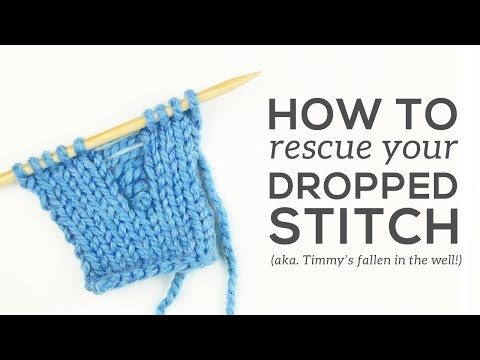
2. Dropping Stitches: It’s easy to accidentally drop stitches, especially when you’re learning. If this happens, don’t panic! Just use a crochet hook or a knitting needle to pick the stitch back up.
How Long Should a Scarf Be?
The length of the scarf is entirely up to you and depends on your height, how you wrap the scarf around your neck and the style you’re going for.
A standard adult scarf length is typically between 60 and 80 inches (152 to 203 cm).
A child’s scarf is around 50 inches (127 cm).
If you’re making a gift and aren’t sure of the recipient’s preference, aim for this range.

For my scarf, I tried it on, wrapping it around my neck twice, to see where it fell on me. I cast off when it measured 75 inches.
Cast Off and Weaving in Ends
Once you’ve reached your desired scarf length, it’s time to cast off (or bind off) and finish your project!
1. Casting Off: To cast off, knit the first two stitches of the row. Then, pass the first stitch over the second one and off the needle.
Continue across the row, always passing the first stitch over the second until you have one stitch remaining.
Cut the yarn, leaving a 6-inch tail, and pull it through the final loop to secure it.
2. Weaving in the Ends: After casting off, you’ll have two yarn ends to weave in: one at the beginning (where you cast on) and one at the end (from your final yarn tail).
Use a tapestry needle to weave each end back into the fabric of the scarf. Be sure to weave the ends in securely but discreetly, so they don’t unravel.
Finishing Tip: When you weave in the ends, make sure to follow the path of the stitches to keep the ends from showing through the fabric.
To see a full demo of how to cast off and weave in ends, please watch the scarf video above at the 21:22 mark.
Congratulations! You’ve now learned how to knit a scarf from start to finish. Wear it with joy and pride!