
How to Bind Off in Pattern (Easy Tutorial)
May contain affiliate links (what's this?)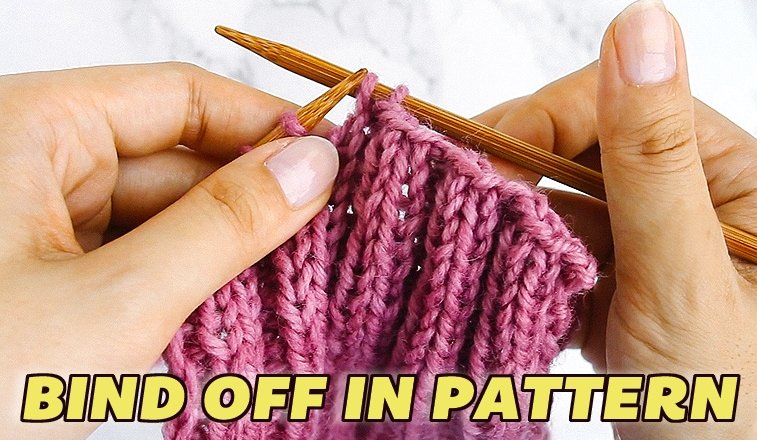
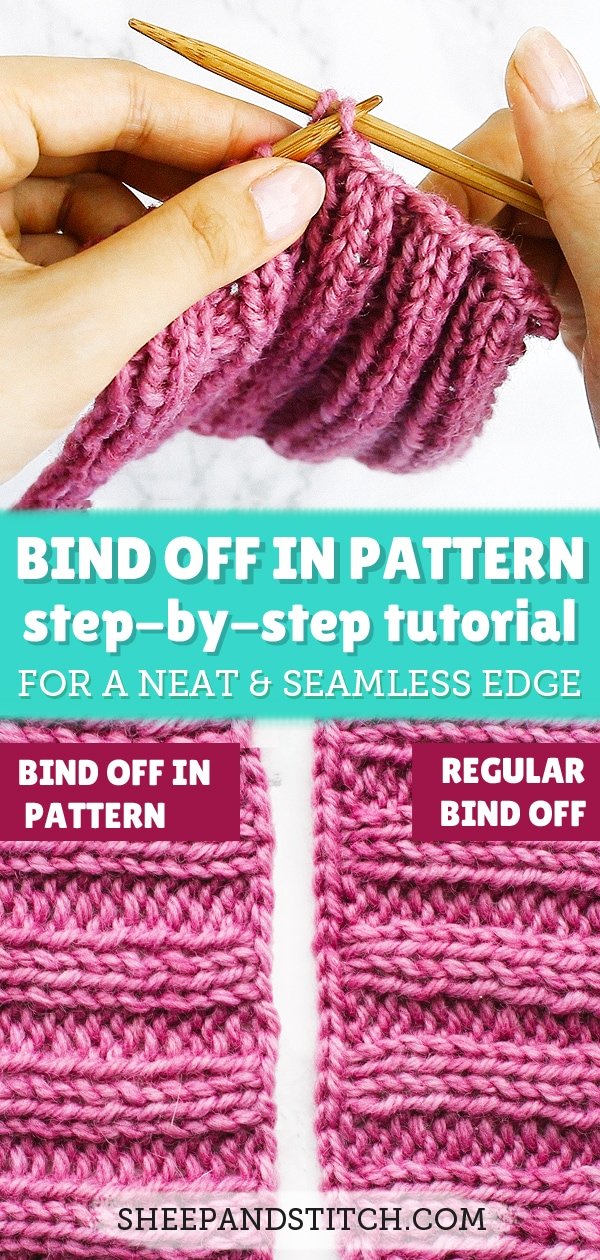
Binding off in pattern is a technique that’s often used when you’re binding off rib stitch.
Unlike a regular bind off, where you knit all the stitches on the bind off row, binding off in pattern requires that you knit the bind off row as if you were working the next row of your stitch pattern.
The result is a bind off that seamlessly blends into your stitch pattern. It can also keep the knitting from stretching or flaring out, and generally looks a bit neater.
The good news is that binding off in pattern is very easy to do.
Just remember to work the two stitches of the bind off as if you were knitting the next row of your pattern.
Bring the first stitch over the second stitch. Then, knit the next stitch as if you were working the next stitch in the stitch pattern. Bring the first stitch over this stitch. Continue binding off in this manner. That’s it!
Bind Off in Pattern Video Tutorial

To watch how to bind off in pattern, watch the video tutorial above. I go through how to bind off 2×2 rib and seed stitch in pattern.
Compare Regular Bind Off to Bind Off in Pattern
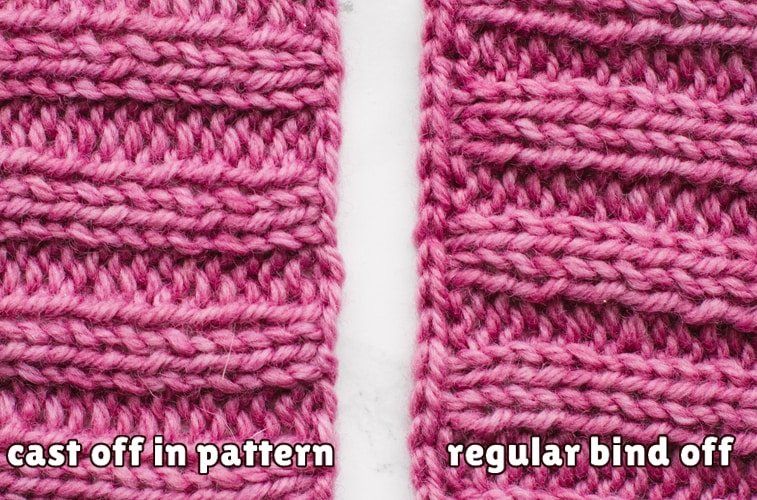
Take a look at a regular knit bind off and binding off in pattern for 2×2 rib. (Note that “cast off” and “bind off” mean the same thing!)
This is another close-up example of a regular bind off and binding off in pattern for seed stitch:
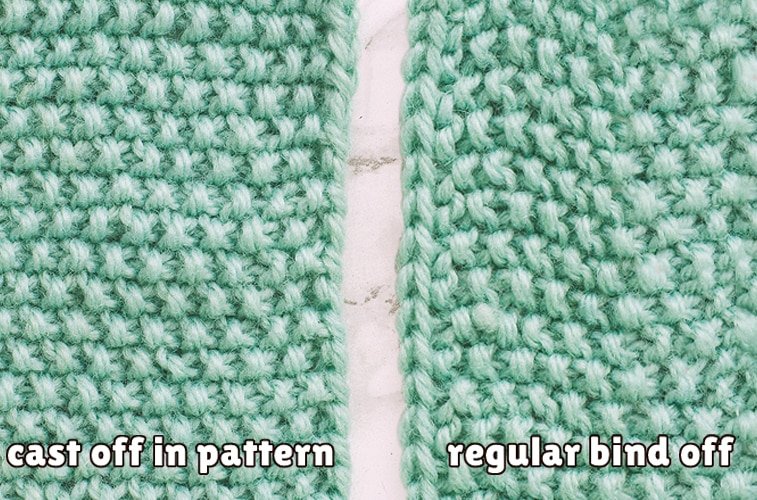
You’ll notice that in both examples, the bind off merges into the knitting more smoothly than a regular bind off.
Ultimately whether you choose to bind off in pattern or in the regular way is up to you! Some knitters like the look of a bold regular bind off while others favour the subtlety of an edge bound off in pattern.
That’s the great thing about knitting – you can customise your work however you please!
BIND OFF TIP: keep a loose hand when binding off, especially if you’re dealing with ribbing. This will keep the bind off elastic and springy!
Some knitters find it awkward to intentionally keep their tension loose. If you’re in the same boat, consider binding off with a needle that’s a size or two larger than the needles you’re knitting with.
Related Videos:
- How to Cast Off Knitting for Total Beginners
- Rib Knitting for Beginners
- How to Knit a Seed Stitch Scarf or Cowl

If I cast off 2 stitches either end then it says continue in pattern for 4 more Rows, do you the following rows mean I skip the first 2 and last 2 stitches of the pattern since they’re now cast off? Eg if the pattern says k2,p2 to end but then I have to cast off 2 do I then start the following rows on p2 since my 1st k2 would now be cast off? Thank you so much for the help
You shouldn’t have to do mental arithmetic to follow the pattern, so skipping something written in the pattern is probably not right. Check how your pattern is written. If it looks something like:
Row 27: Cast off 2. K2,P2 until 2 before end. Cast off 2.
Row 28: Cast off 2. P2,K2 until 2 before end. Cast off 2.
Continue in pattern for next 4 rows.
Then this would be decreasing *every row* by casting off two at the beginning and end of each row, and would be a 2×2 ribbing. So if I had 64 stitches at the end of row 26, by the end of row 27 I would have 60, then 56 at the end of row 28, and continuing to decrease the number of stitches on my needles by 4 each row until I had only 40 stitches at row 32 but all my knitting still looks like a standard 2×2 rib. The biggest “difference” between rows would just be how many times I had to repeat the K2,P2 until I reach the 3rd-to-last stitch and need to do the cast off again.
If the pattern looks like:
Row 28: Cast off 2. K2,P2 to end.
Continue in pattern for 4 more rows.
Then you still have a 2×2 ribbing, but you only decrease by 2 stitches each row. Since you are dropping 2 stitches per row and this is 2×2 knitting, you will have already functionally “skipped” the wrong type of stitch, if that makes sense. So for Row 29, when I finished Row 28 and the last 4 stitches are KKPP, on the wrong side I would see this as PPKK. So when I cast off 2 at the beginning of row 29, I would cast off the two purl stitches, then I could go directly to the K2,P2 as written in line 28 for the repeat because the cast off stitches “fixed” aligning my knit and purl stitches. Since K on the right side is P on the wrong side, and similarly when you turn the work between rows, a P stitch becomes a K stitch (we just name them for what they look like facing the knitter, so once we rotate the work when changing rows we switch which side of the same stitch we are looking at for K and P stitches).
Unless patterns explicitly tell you to pick up, slip, or drop stitches, the instructions apply to just whichever stitches are still currently on the needles.
That’s a very long-winded explanation and a bit late, but hope it helps.