
What is Worsted Weight Yarn? – A Beginner’s Guide
May contain affiliate links (what's this?)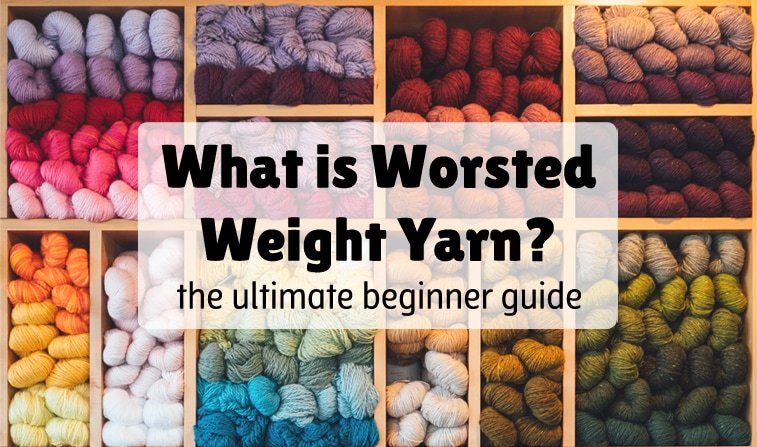
If you’re wondering, “what’s worsted weight yarn?” then you’ve come to the right place!
Yarns come in many shapes and sizes. They can be as thin as a cobweb (like a lace-weight) and as thick as a soda can (like jumbo yarn for arm knitting).
Worsted weight yarn is a medium weight yarn that sits in the middle of the yarn weight family. It’s thicker than sock and sport weight and thinner than bulky weight yarn.

Its medium thickness means that it’s great for knitting sweaters, hats, scarves, mittens, blankets and beyond!
Because worsted yarn is so “knittable,” I think of it as an all-purpose yarn. When in doubt, grab a worsted weight.
And get this!
I’m not the only one who believes this.
According to large-scale yarn manufacturers Lion Brand and Bernat, their most popular yarn weight for knitting and crochet is – you guessed it! – worsted weight yarn.
Within the yarn weight family, think of worsted yarn like the popular middle child – the Kim Kardashian of yarn weights, if you will.
Table of Contents
Worsted Weight Yarn Comparison
Because yarns come in so many different sizes, the Craft Yarn Council (CYC) created a standardised yarn weight system to bring unity and order to the yarn world.
This system is widely adopted among crafters, yarn manufacturers, designers and publishers, so consider it the gold standard for categorising yarn weights.
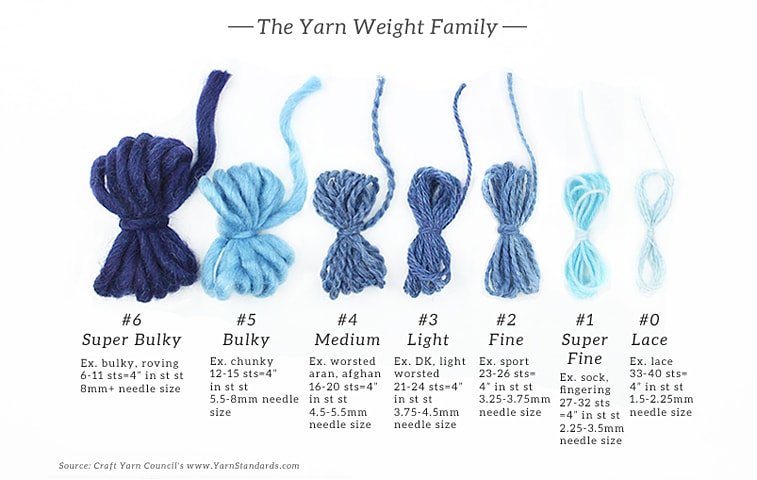
Each yarn weight is assigned a number, beginning with lace weight at 0 and going up to jumbo yarn at 7.
In the UK and Europe, yarn weights are more often referred to by their numbers. For instance, a French knitter may talk about a “number three yarn” instead of a “DK weight.”
In North America, yarns are often referred to by their descriptive names, like a “worsted yarn” instead of a “number four yarn.”
Under this system, worsted yarn is considered a medium weight number four yarn with a knitting gauge of 16-20 stitches for every four inches of knitting.
When shopping for worsted yarn, look for the word, “worsted” or a prominent number four on the yarn label.
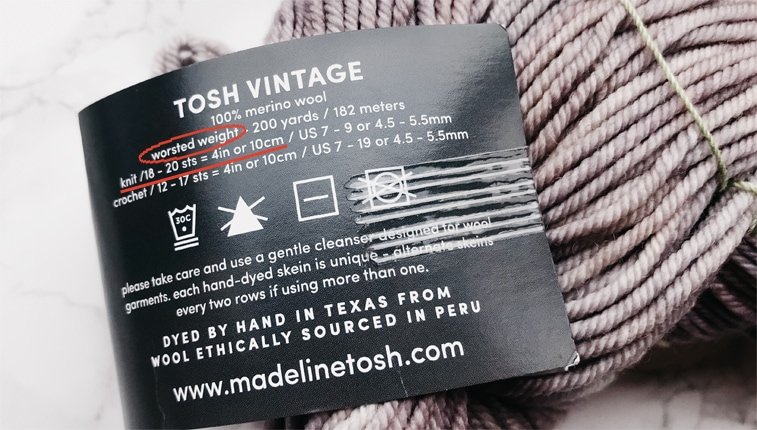
If both are absent, check the knitting gauge to see if it falls within 16-20 stitches for four inches of knitting.
To make matters slightly more complicated, worsted weight yarn is also sometimes called “Afghan” or “Aran” weight.
What Needles to Use for Worsted Yarn
The needle size for worsted yarn varies depending on the project.
In general, a 4.5 to 5.5 mm (US 7-9) needle will produce a firm yet pliable fabric. I would consider this the “standard” fabric – neither tight nor loose, but just right.
For lace knitting with worsted yarn, it’s recommended to go up several sizes to a 6.0 to 8.0 mm needle for open lacework.
If knitting socks, potholders or dish towels, which need a tighter tension, go down several sizes to a 3.25 to 4.0 mm needle for a stiff and sturdy fabric.
But remember:
These are general guidelines. Your best bet is to look to the yarn label, which should provide a “recommended needle size” for knitting “standard” fabric.
From there, go up or down a needle size (or sizes) to get the exact knitting tension for your project.
A Word About Worsted Yarn and Plies
The best way to understand yarn plies is through a visual:
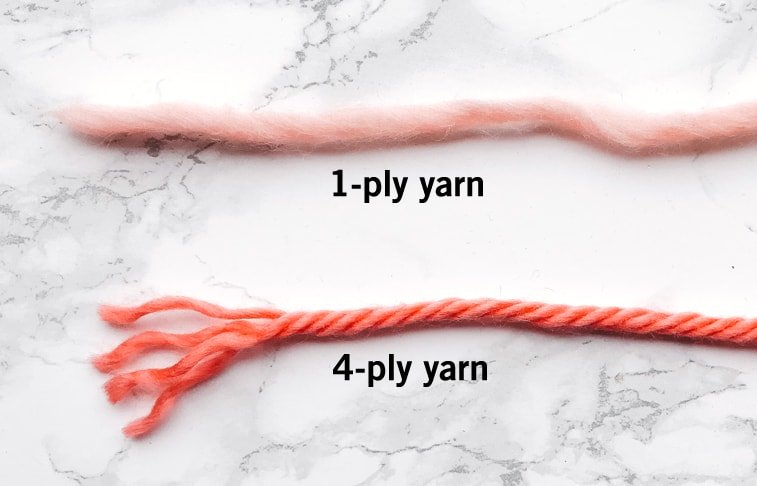
You can think of plies as super thin mini yarns that are spun together to make a larger strand of yarn.
When three plies are spun together, the resulting yarn is called a three-ply yarn.
If two plies are spun together, the result is a two-ply yarn.
Even one ply of yarn can be twisted to create a single-ply yarn.
Yarns can be made up of as many as eight plies of yarn! Eight-ply yarns are often called a “cabled yarn” since the eight plies are braided into a smooth cable.
Worsted yarns come in a variety of plies – from one-ply to eight-plies.
When thinking about plies, the general rule is that the more plies of yarn, the less likely the yarn will pill and break.
Twisting plies together gives the resulting yarn strength and body.
A single-ply yarn can be easily broken if you pull of each end hard enough. However, if you twist two single-plies together, the resulting two-ply yarn will be a lot harder to tear apart.
So, when choosing a worsted weight yarn, consider what your final project will be.
If you plan to knit a cushy cowl, a single-ply is an excellent choice.
However, if you’re knitting a pair of hard-wearing mittens, consider a three or four-ply yarn.
My Favourite Worsted Weight Yarns
What discussion on yarns would be complete without some yarn eye candy?
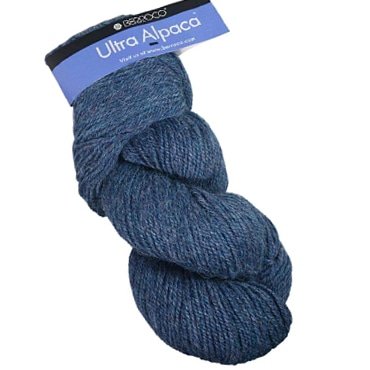
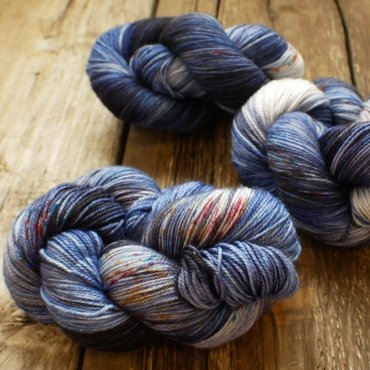
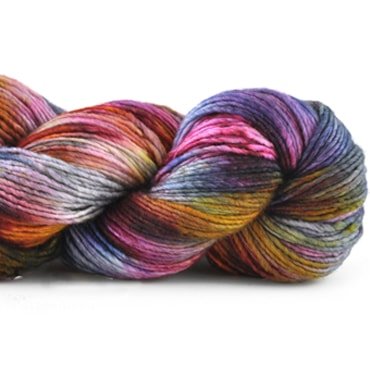
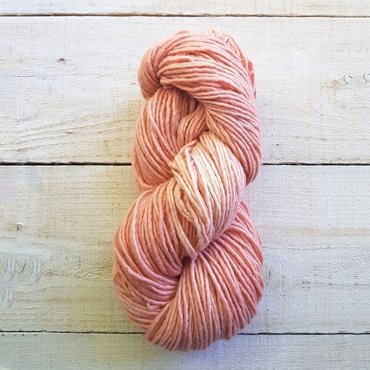
Here are a handful of my absolute favourite worsted yarns. Some are a lofty single plies while others are a hefty four-ply.

I haven’t touched knitting needles for just on 40 years so I have to start from scratch. I am loving every minute of it and it all comes back. I was a continental style knitter and find it is so much easier and much faster.
Thank you for your explicit instructions they are very helpful and great reminders of my once knitting skills.
Knitting is a bit like riding a bike. Once you’ve learned it, you can kind of pick it up again with a bit of practice! Glad you’re enjoying the site 🙂
Thank you for the great video
I live in Mexico and I’m learning crocheting now and what made me do it was seeing all these animals in need and I just want to help! I want to stand by Australia the country Australia the people and Australia the animals
So thank you again
Bevita
I love your website, your tutorials, are very clear and easy to understand!
Hello Davina,
I’ve come across an easy blanket pattern with American wool and needles. They are suggesting using Worsted medium weight 4 with size 17 circular needles.
In Australia is that wool size 8 and needle size 12 please? I’ve also never knitted with circular needles so I hope it won’t be problematic.
Thank you,
Elizabeth
I know this is a very late reply but size 17 us needles is size 12 AUS and yarn is 12 ply AUS.
Thank you for sharing your knowledge. It’s very helpful. What yarn do you recommend to knit amigurumi? Thank you! Graciela
I so appreciate that your “beginner” information is actually worded for beginners. I’ve learned so much just from 1 article! Thank you! I love to crochet but in the past had to give it up because different terms used were confusing. Now I’m getting it!!
I am wanting to work on a 7 mesh plastic canvas to make squeezable cheeks Santas. The directions call for worsted weight yarn. I’m not a knitter, so have no idea what size yarn I need. Can you help me know what to look for? The directions also call for a #16 tapestry needle if that helps let you understand what I’m looking for.
Thanks this was a great tutorial. I am a beginner who needs a new hobby.
This is very helpful, thanks. I bought a knitting book for beginners but they started talking about worsted and plies without explaining exactly what those words mean so this article has been perfect!
Bonjour
Pouvez-vous me dire quel grosseur de fil je fous acheter pour le canevas plastique numéro 7 . Merci
I have a pattern that uses 18 1/4 oz worsted yarn. Would this be the bulky yarn? And where might I find it?
12 ply or US number 4.
I love your site, thank you for all the information. I’m in South Africa – what is the equivalent to our Double Knit (DK)? I’ve knitted for many years as a youngster, but have also been out of the game for many years and now I’m back and seriously confused. I know single ply, 4 ply, DK, Chunky but everything has changed!!
Thank you for this brilliant explanation 👏
I live in Australia and I find understanding some terms used for yarn hard to understand.
Here we mainly look at what ply a yarn is.
In fact I thought the amount of plys is what tells you the weight category.
How do we work out the ply with Worsted yarn?
I am thrilled to have found your site!
Happy to have you!