
Knitting Needle Sizes and Conversion Chart (Free Printable)
May contain affiliate links (what's this?)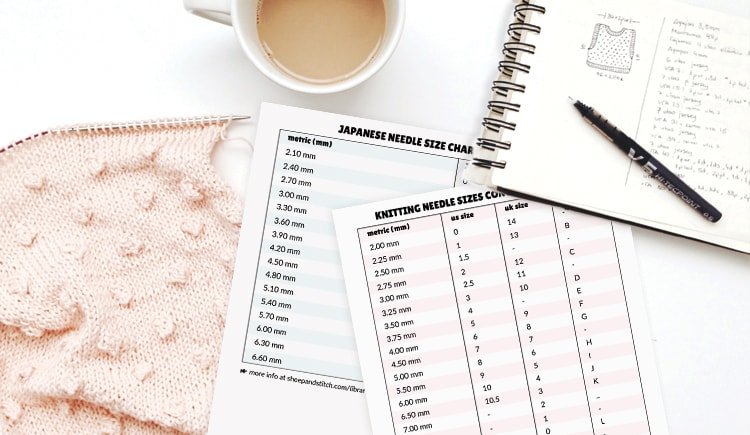
Knitting needle sizes can be confusing. That’s because different countries have different ways of numbering their knitting needles.
To help you decipher the world of knitting needle sizes, refer to the charts below!
Knitting Needle Sizes Chart for US and UK
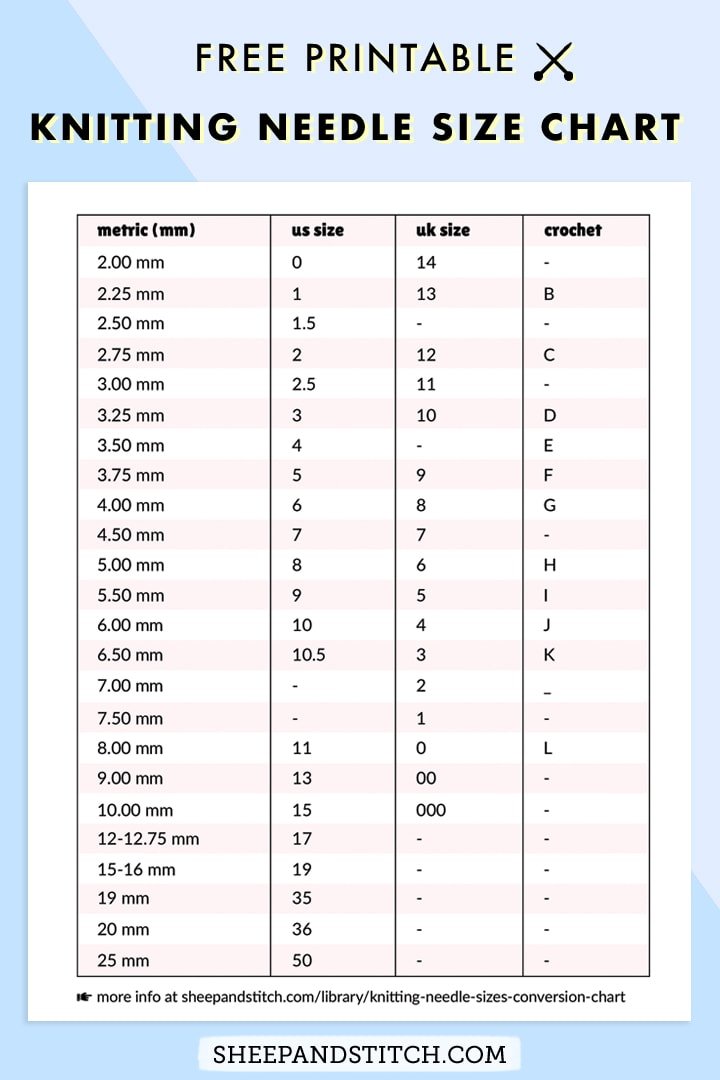
This knitting needle size conversion chart compares knitting needles in the US and UK, with crochet hook sizes thrown in for good measure!
| Metric (mm) | US Size | UK Size | Crochet |
|---|---|---|---|
| 2.0 mm | 0 | 14 | – |
| 2.25 mm | 1 | 13 | B |
| 2.5 mm | 1.5 | – | – |
| 2.75 mm | 2 | 12 | C |
| 3.0 mm | 2.5 | 11 | – |
| 3.25 mm | 3 | 10 | D |
| 3.5 mm | 4 | – | E |
| 3.75 mm | 5 | 9 | F |
| 4.0 mm | 6 | 8 | G |
| 4.5 mm | 7 | 7 | – |
| 5.0 mm | 8 | 6 | H |
| 5.5 mm | 9 | 5 | I |
| 6.0 mm | 10 | 4 | J |
| 6.5 mm | 10.5 | 3 | K |
| 7.0 mm | – | 2 | – |
| 7.5 mm | – | 1 | – |
| 8.0 mm | 11 | 0 | L |
| 9.0 mm | 13 | 00 | – |
| 10.0 mm | 15 | 000 | – |
| 12-12.75 mm | 17 | – | – |
| 15-16 mm | 19 | – | – |
| 19.0 mm | 35 | – | – |
| 20.0 mm | 36 | – | – |
| 25 mm | 50 | – | – |
Japanese Needle Size Chart
Note that Japanese needles have a different metric size than US and UK needles.
| Metric (mm) | JPN Size |
|---|---|
| 2.1 mm | 0 |
| 2.4 mm | 1 |
| 2.7 mm | 2 |
| 3.0 mm | 3 |
| 3.3 mm | 4 |
| 3.6 mm | 5 |
| 3.9 mm | 6 |
| 4.2 mm | 7 |
| 4.5 mm | 8 |
| 4.8 mm | 9 |
| 5.1 mm | 10 |
| 5.4 mm | 11 |
| 5.7 mm | 12 |
| 6 mm | 13 |
| 6.3 mm | 14 |
| 6.6 mm | 15 |
While the US and the UK use the same metric sizes, their numbering systems run in opposite directions.
In the US, needle sizes start at 0 and increase to 50. However, in the UK, sizes start at 14 and go up to 000.
In Japan, knitting needles use different standard metric sizes, starting at 2.1 mm and going up to 25 mm.
What is My Knitting Needle Size?
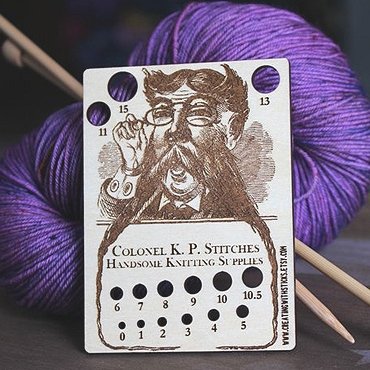
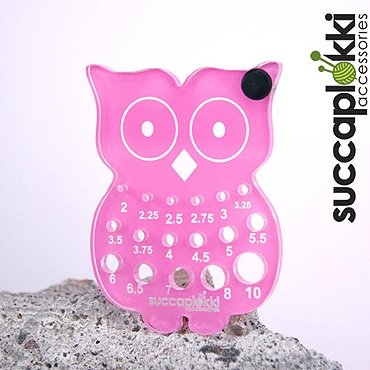
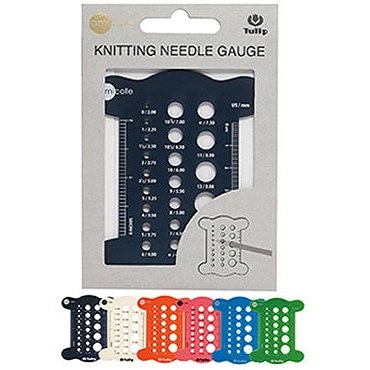
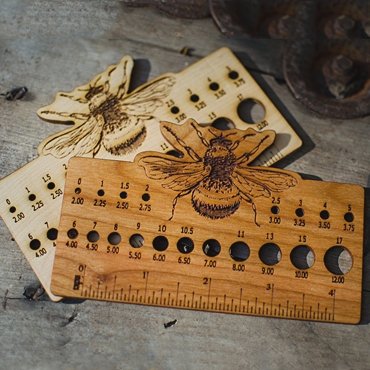
If you have knitting needles from all over the world or of unknown origins, your best bet for identifying their size is by using a knitting gauge.
A knitting gauge is a small tool made of plastic, metal or wood. Like a slice of Swiss cheese, it has a bunch of variously sized holes all over it.
Unlike Swiss cheese, these holes are precisely sized for measuring knitting needles!

This is how it works:
Take your mystery needle and poke it through a similarly-sized hole in the knitting gauge.
If the needle slides in smoothly and sits snugly in the hole, then you’ve just identified your needle size. Mystery solved!
A knitting gauge is super useful, and every knitter should have one in their toolbox.
Thankfully, there’s one to suit every knitter’s personality and needs, from animal lovers to those looking for plain utilitarian plastic. Below, some highly-rated favourites:
Knitting Needle Size Chart Printable
To make your knitting easier, I’ve made a printable of these charts, which you can download below.
Print it out, laminate it, and keep it handy for future questions on knitting needle sizes.
And there you are! May these two knitting needle size conversion tables help you on your knitting journey!

What if gage fits one way but not the other? It usually fits across but is bigger up and down.
I have minimal sight and miss knitting and crocheting very much, have been given 35 mm knitting needles, yes THIRTY FIVE MM I presume I can only make squares which is OK but have no idea of the yarn size I should use.
Help please
Wow! 35mm needles sound… enormous! I’d think big yarn meant for arm knitting might work?
My assorted crochet hooks have millimeters and also numbers 3,4 5, 6.
I have no A,B,C’s
I don’t see a link to make this print other than printing the webpage
Hi,
This might seem like a silly question but I haven’t found the definitive answer.
I am knitting with 5 mm needles and I read that in order to achieve greater stretch in a cast off I can increase the needle size twice. Does increasing the needle size twice mean going from 5 mm to 6 mm?
Or does it mean going from 5 mm to 7 mm?
Thanks in advance for your help.
Sorry for the late reply. This is a great question! Yes, it’s increasing the needle size is a great little hack for getting a stretchier cast off. I typically increase by 1mm (so from a 5mm to a 6mm) but going up to 1.5mm doesn’t hurt either.
Thank you for sharing the chart. It is very useful
Is needle gauge measured in diameter or circumference?
It’s measured flat from left to right
Diameter.
I just want to know what stitch the top picture is. 😊 love your YouTube. It’s so helpful.
It looks like stockinette stitch interspersed with bobbles.
Hi! I have a needle sizer that appears to be Chinese. Do you have a conversion chart for that?
I need to use US 19mm so do I need 000 UK pins?
When trying to determine the size of my knitting needles, when you say the needle should glide into the holes in the guide, do you mean they should glide in all the way up the needle or just the part that is shaped at the tip and then get stuck?
What is the best size knitting needles to have in your starter kit (circular and straight)?
This conversion chart is so helpful! I’ve been struggling to find the right needle size for a project, and this chart makes it so much easier. Thanks for sharing!
I have a pattern that calls for size 15, size 35 and size 50, which looks to be 4 needles knitted with each size being a side. It really looks and reads extremely confusing. do you think using a size 15 circular would work rather than fumbling with 3 sizes at a time? I am doing it for a friend and the yarn is bulky. Not a comment but a question
I’ve knit a jumper on size 10 & 8 if I want it a bit bigger do I go to a size 9& 6
The US absolutely DOES NOT have knitting needles that come in HALF sizes!!! I have been knitting since I was 5 and in a few months will be 76! The charts showing this are so wrong! So that leaves the knitter in the US having to try the closest by swatching and that is sometimes so frustrating. A lot of the free patterns are for yarns that are no longer in production. And last point way back in 2005 the fingering wt and baby sprot wt was changed by some companies. Like the patterns I have from my great grandmother using fingering now are a joke! And when knitting for preemies NO wool what so ever is to be used not even Merino. And I am allergic to it also. VERY frustrating!
Yes we do have some half-sized knitting needles. US1.5 (2.5mm), US2.5 (3.0mm) and US10.5 (6.5mm). Check your LYS or Amazon for sizes. Big name brands carry them like ChiaoGoo, Knit Picks (KnitPro), Addi, and HiyaHiya. If you don’t believe me call the companies yourself and ask.